
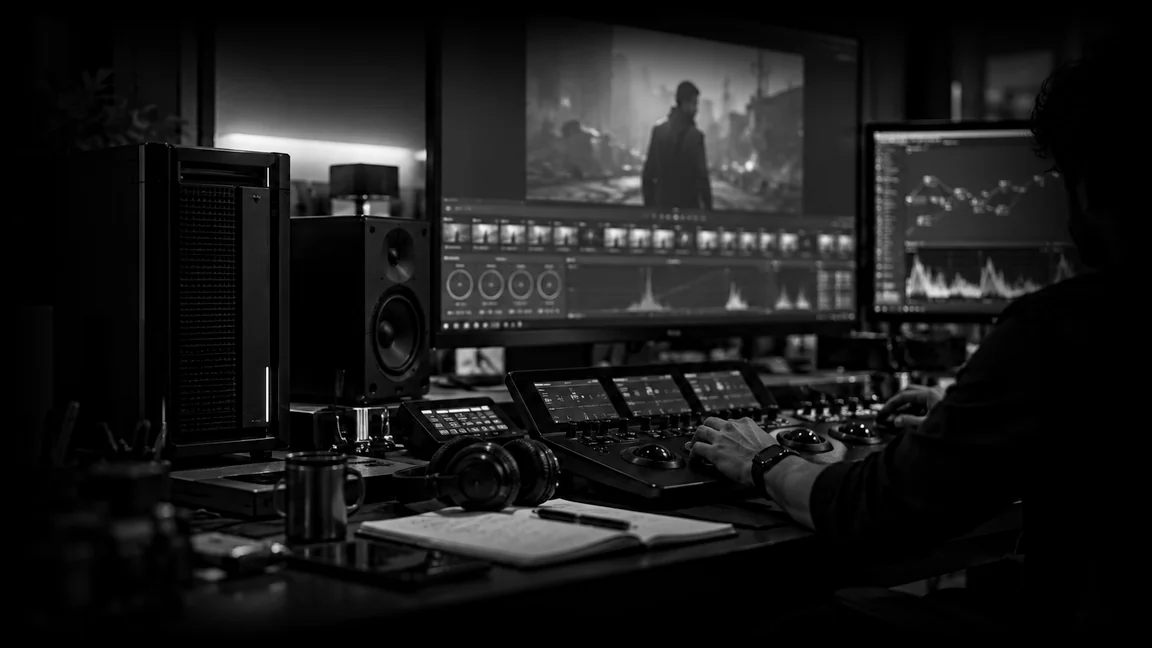
From edit bay to LED volume, on hardware you own.
Workstations, render nodes and synchronised stage systems for post-production, VFX, virtual production and audio.
The constraint
A post or VFX pipeline runs at the speed of its slowest node. One seat that runs out of GPU memory on a high-resolution timeline, or one render node that throttles under sustained load, holds up the whole delivery. On an LED volume, every render node also has to present frames in lockstep with the camera.
Workloads
Editing, grading & finishing
Cut and grade high-resolution timelines in Premiere Pro, After Effects and DaVinci Resolve, with the GPU carrying the effects load.
3D, VFX & animation
Render shots across a rack of GPU servers instead of a single tower, using GPU renderers such as Redshift, Octane and V-Ray GPU.
Virtual production & ICVFX
Run Unreal Engine nDisplay clusters for LED volumes.
Audio production
Run plugin-heavy sessions at low buffer sizes. Audio is CPU-bound, so these builds spend on single-core clock speed and quiet cooling, not on the GPU.
Systems
- GLabs AI Workstations — edit, grade, artist and audio seats.
- GLabs GPU Servers — render farm nodes and nDisplay stage nodes.
- GLabs Vault — shared media storage for the whole facility.
Deployed with
GLIDS. Seats, render nodes and storage go in as one facility system, tested end to end before handover.
Related solutionsPro Creators
FAQs
What GPU do I need for DaVinci Resolve at high resolution?
Resolve runs most image processing on the GPU, so GPU memory and GPU count both matter as resolution rises and effects like noise reduction stack up. Premiere Pro and After Effects lean more on the CPU and fast storage alongside the GPU. We size each seat to your codec, resolution and effects stack, not to a generic spec.
What hardware does an LED volume need?
Each section of the wall is driven by a render node running Unreal Engine nDisplay. Those nodes need professional GPUs with sync cards, so every node presents frames on the same timing signal as the camera. We build and test the node set as one cluster.
Is an owned render farm cheaper than cloud rendering?
It depends on utilisation. For a studio rendering most weeks of the year, owned nodes can cost less over their life than rented cloud GPU time, and unreleased content stays on your premises. Many studios keep cloud for peak overflow only.
Do you build dedicated audio workstations?
Yes. Audio builds prioritise single-core clock speed, stable low-latency behaviour and quiet cooling, with a modest GPU unless the session needs more.
Send us your delivery spec. We'll build the pipeline to meet it.
All product and company names mentioned are trademarks of their respective owners.